Walk into an older cutting workshop in Valenza, or a cameo bench in Torre del Greco, and the sound is the same: a low motor hum, water ticking onto a spinning lap, and someone holding a stone at an angle you cannot quite read. Nothing about it is fast. That is rather the point.
Italy has never been the world’s volume lapidary. The country’s reputation sits in the last few percent — the finishing, the setting, the recutting, the eye that decides where a table should fall on a piece of rough that has already been argued over by three other people. For anyone who buys, wears or inherits jewelry, that tradition is not nostalgia. It is a set of working habits you can actually use.
Italian gem work is rarely a standalone industry. It lives attached to jewelry manufacturing, which is why the map looks the way it does.
Valenza, in Piedmont, is a gold town: hundreds of small firms, many of them family-run, where cutting, setting and finishing benches sit within a few metres of each other. Vicenza and Arezzo work in a similar rhythm — production-led, with a strong bias toward calibrated goods and precise setting. Torre del Greco, south of Naples, is the coral and cameo town, a place where carving has been passed down through families for generations. Florence holds the hardstone tradition, with the Opificio delle Pietre Dure founded at the end of the sixteenth century and still operating today, largely as a conservation institute. Milan and Rome contribute high-jewelry benches, restoration and gemological laboratories. Venice brings its bead and glass history into the same conversation.
The common thread is scale. Most of these workshops are small, and many are content to stay that way.
The apprenticeship model still shapes how Italian cutters and setters learn, and the first lesson is boredom. A beginner may spend weeks on rounds and cabochons before touching anything valuable. The point is not the shape. It is the lap — learning to feel when a wheel is running true, when it is glazed, when the water flow is wrong, when a facet is about to round over.
Then comes the part that separates a decent stone from a good one: the final polish. Beginners rush it. Experienced hands slow down.
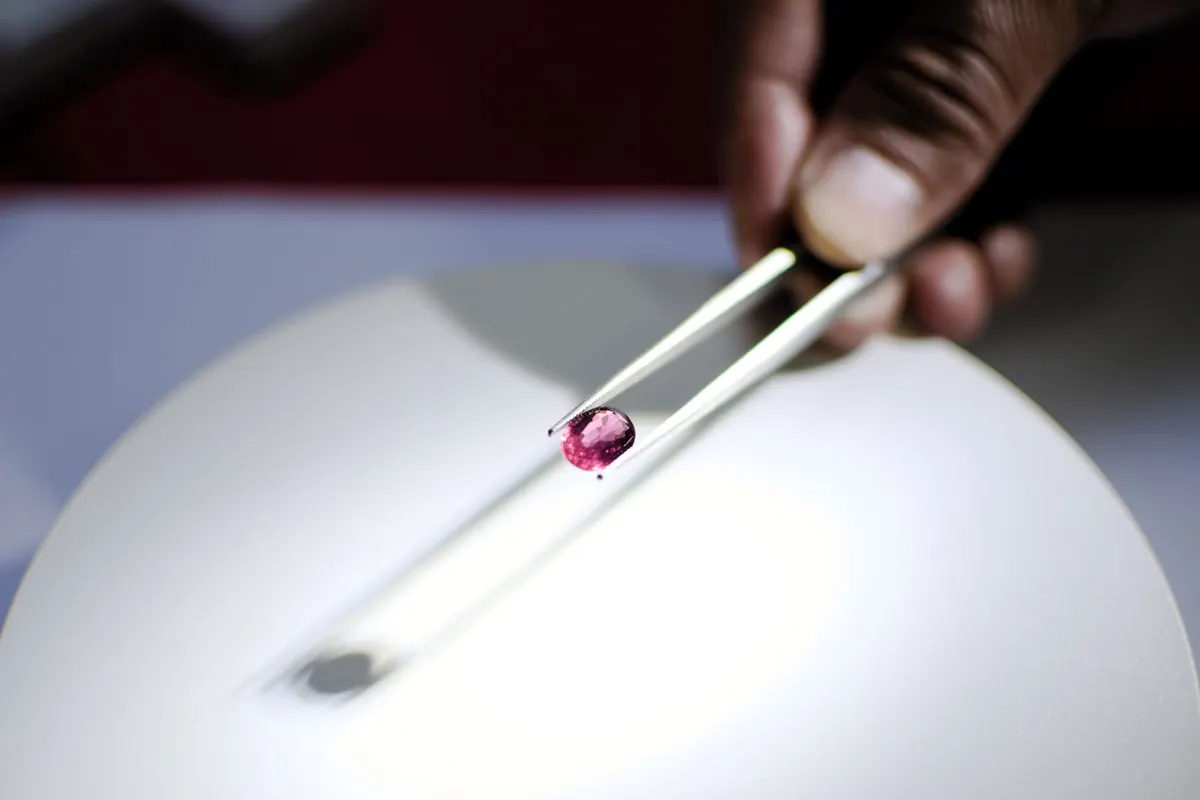
Most of what you pay for in a well-cut stone is invisible at arm’s length. Under a ten-power loupe, look at the girdle — is it evenly bruted or faceted, or does it wobble? Look at where facets meet; do the junctions close cleanly or leave a thin, flat sliver? Look at the polish for a faint haze or fine directional scratches. These are the details the old benches obsess over, and they are the ones that survive fifty years of wear.
Much of the world’s cutting is driven by yield percentages and standard proportions. Italian benches tend to work the other way round: the rough decides, and the cutter weighs beauty against weight in a calculation that has no clean formula.
A cutter opening a piece of rough has to choose an orientation before anything else. Where is the colour strongest? Is there a veil or a feather that can be hidden under a prong, or better, cut away entirely? Can the table be tilted slightly to catch a richer tone without producing a window through the middle of the stone? Should the pavilion be cut a little shallower to keep a valuable extra half-carat, accepting a slightly quieter stone?
This is why some older stones look “wrong” against a modern grading chart. A table that is a touch off-centre, or a crown a degree or two flatter than the ideal, may not be sloppy work. It may be a decision made by someone who could see the rough and knew what would be lost by cutting it differently. That does not make every odd stone a hidden treasure — some are simply badly cut — but it is worth asking the question before you dismiss one.
Italian jewelry production relies heavily on calibrated stones: rounds supplied in fixed diameters, commonly in steps of a quarter or half a millimetre, so that hundreds of stones sit level in a pavé surface or a channel. It is a system built for setting benches, and it has a practical consequence for owners.
If a small stone falls out of a pavé band, the jeweller’s first question is not about colour or clarity. It is the measurement. A stone recorded as “about two millimetres” is a nuisance; a stone recorded as 2.25 mm can usually be matched from stock. When you buy a piece set with small stones, ask for the millimetre sizes and write them down with the receipt. It takes a minute and can save weeks.
Cameos from the Torre del Greco workshops are usually carved from layered marine shell — helmet shells and the queen conch among them — where a pale layer sits over a darker one. The carver sketches onto the surface, then cuts the relief so that the figure stands in the light layer against the coloured ground. Coral work sits alongside it, with its own vocabulary of beads, branches and carved panels.
When you look at a cameo, the questions are different from those you would ask of a faceted stone:
If you are buying coral, check local rules on trade and import before you commit, and ask for documentation where it is required. Repairs and fillers exist in this market, so buy from someone who will put their description in writing.
Pietre dure — hardstone inlay — is a different craft again. Slabs of agate, jasper, lapis and chalcedony are cut, shaped and fitted edge to edge, then polished as one flat surface so the joins all but disappear. The skill is in the drawing and the saw, not in the polishing wheel.
To judge it, tilt the piece under a raking light and look along the seams rather than at the picture. Fine, consistent joins and a continuous polish across different materials indicate real work. Care is straightforward but unforgiving: keep these pieces away from heat and sudden temperature change, do not soak them, and skip the ultrasonic cleaner. A soft, barely damp cloth is usually enough.
None of this requires you to become a lapidary. It requires a few habits.
The old workshops are not museums, and the people working in them are not sentimental about the past. They kept the parts that worked: slow decisions, careful finishing, and a respect for what the material will and will not do. That is a decent standard for anyone buying a piece of jewelry — and a better one than most sales floors will ask of you.
Photo: Jorge Romero / Pexels